The U.S.A.’s New Passport, which says, “Welcome, but be good!” President DJT

Understanding Passports
- A U.S. passport is an official government document that verifies your American citizenship and requests safe passage for you in foreign countries.
- It allows you to travel internationally, access U.S. consular assistance abroad, and legally re-enter the United States
- A U.S. passport does not welcome foreigners to the U.S.
The Passport Is Not a Campaign Brochure
Why Is a Menacing Trump Glowering From Inside an American Passport?
And why is “welcome, but be good” the written message?
Michael Seller’s Substack: The Passport Is Not a Campaign Brochure
A U.S. passport is one of the most basic documents of citizenship. It is not partisan. It is not personal. It is not supposed to belong to the president who happens to be in office when it is issued. It belongs to the citizen.That is what makes this so jarring. A passport is not like a campaign hat, a rally banner, or a commemorative coin sold on late-night television. It is an official document of the United States government. It tells foreign governments that the bearer is an American citizen and is entitled to the protection of the United States.
The design of a passport therefore matters. Not because most people spend hours studying the interior art, but because the document carries the authority of the American state. It represents the country. It represents continuity. It represents the idea that the United States is larger than any one leader.
Putting Trump inside that document reverses the logic.Instead of the passport saying, “This citizen belongs to the United States,” the visual message becomes something closer to: “This United States belongs to Trump.”
The Glower Is the Point
The new image is not warm. It is not dignified. It is not reflective. It is not presidential in the old civic sense of that word.
It is a dominance image.
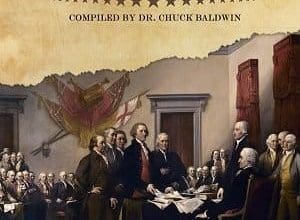
Trump is leaning forward, eyes fixed, shoulders squared, hands planted. The Declaration of Independence appears behind him, but it does not command the scene. He does. The emotional message is not liberty. It is not citizenship. It is not national unity. It is control.
And that is what makes the image so revealing.
Someone — Trump, the White House, the State Department, or whoever is guiding the visual language of this administration — apparently looked at a passport commemorating the Declaration of Independence and decided the image should not communicate confidence, freedom, welcome, or shared national inheritance.
It should communicate menace.
That choice matters because official imagery is never neutral. Governments use symbols to tell people what kind of country they are living in. In a democratic republic, the symbolism usually points outward: to the people, the land, the founding documents, the institutions, the history. In authoritarian politics, the symbolism points inward: to the leader.
That is what this passport image does. It turns the anniversary of the nation into another occasion for the projection of Trump’s personal power.
The Founders are on the facing page. Trump is on the other. But visually, the Founders are history. Trump is authority.
“Welcome, but be good” is not the language of citizenship.
It is the language of a landlord. Or a bouncer. Or a king.
It implies that entry into America — or perhaps membership in America — is something granted by the ruler and subject to revocation if the subject misbehaves.
The Passport as Warning Label
This is why the image feels so wrong.
It is not merely vanity, although it is certainly that. It is not merely tacky, although it is certainly that too. It is that the image transforms the emotional meaning of the passport.
A passport should say: you are a citizen of a republic.
It should also say something to the rest of the world: this person travels under the protection of the United States. Treat the bearer of this passport with the dignity and respect owed to an American citizen.
That is the outward-facing logic of a passport. It is not a warning from the president to the citizen. It is a document by which the United States vouches for the citizen abroad.
Which makes Trump’s message — “Welcome, but be good” — so strange.
That makes no sense inside an American passport. The passport holder is not being welcomed into America. The passport holder is American. The document is not a favor granted by Trump. It is evidence of citizenship.
To use that document as wallpaper behind Donald Trump’s scowling face is already bad enough.
To pair it with “Welcome, but be good” is worse. It takes a document of citizenship and makes it feel like a warning label.
The Deeper Pattern
This would be easier to dismiss if it were isolated. It is not.
Again and again, the Trump administration has taken public symbols and pulled them toward Trump himself. The 250th anniversary, which should have been a broad civic commemoration, has increasingly become another stage for Trump’s self-mythology. The line between country and leader keeps getting blurred.
That is the pattern.
The state becomes a branding platform. The anniversary becomes a campaign backdrop. The passport becomes a Trump object. The Declaration becomes scenery. The Founders become supporting cast.
And Trump becomes the face inside the document that belongs to every citizen.
The Question We Should Be Asking
So yes, the obvious reaction is ridicule. It is absurd. It is creepy. It is embarrassing. It looks like something a minor autocrat would commission and then insist was patriotic.
But ridicule is not enough.
The better question is: what kind of mind looks at the Declaration of Independence and sees an opportunity to put Donald Trump in front of it?
What kind of administration looks at a passport and sees not a citizen’s document, but another surface on which to print the leader?
And what kind of political movement looks at America’s 250th birthday and thinks the correct emotional register is not gratitude, humility, or reflection — but a warning?
“Welcome, but be good.”
That is the line Trump chose.
It is a small phrase. But it captures a large problem.
Trump does not seem to understand the passport as a document of citizenship. He understands it as an emblem of control. And he does not seem to understand the 250th anniversary as a celebration of a republic. He understands it as another opportunity to place himself at the center of the American story.
This is just a quick post on the stupidity of it all.
That was my initial thought. And I nearly did not do the post at all. I did a quick hit about the stupidity and was going to move on.
Seconds after posting, I found Seller’s email, which I excerpted above. This goes beyond stupid to something more menacing.
Sellers concluded.
MS Note: As I wrote this, I was gradually bothered by that familiar sense of —oh, why bother? There is so much of this sort of nonsense to react to. And when I react to this, I’m not reacting to something else that may be more important. But still….symbols are important. Trying to understand what is happening around us is important even when it means treating intellectualy unserious actions as serious choices because the impact is serious. Who knows. Each day we get closer to the 250th Anniversary of the Declaration of Independence—and each day America gets farther and farther away from the founding principals embodied in that declaration.
Sellers is continually a great read. I just subscribed.
Article posted with permission from Mish Shedlock