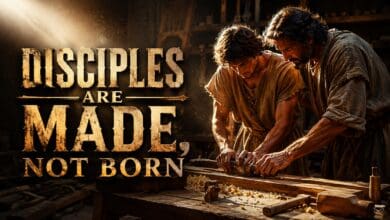
In Contrast To What We See Today, They All Felt Weak, Inadequate, & Unworthy When The Lord Called

“Now when they saw the boldness of Peter and John, and perceived that they were unlearned and ignorant men, they marvelled; and they took knowledge of them, that they had been with Jesus.” -Acts 4:13
Oh, how many we have that are self-assertive when it comes to the call of God. How many have included themselves to partake in that which they have no part when it comes to spiritual matters? Let me tell you, America is filled with them. You know who I am addressing, do you not?
I am speaking about those who want to be in a position of pretended spiritual authority who have never been given such by the Lord. These are those (highly esteemed -Luke 16:15) who receive accreditation and ordination from other men. They are self-qualified and self-sustaining (loving the praise of men rather than the praise that comes from the Lord alone-John 12:43); those who gloat in their own self-righteousness, a self-righteousness that Paul, in fact, found to be but “dung.” Yet, he did not have his own righteousness, but that which is to be found in Christ. Read Philippians 3:4-14
These are those who led this country into the state of hell and decadence that is rapidly becoming America’s reality (Psalm 9:16-17). What has been the outcome of these carnal men who have put themselves in the pulpits across this country (John 10:12)? Also, read Matthew 15:13.
It has been rightly stated that “those that want to be in the pulpit are called of the devil, and those that do not, are called of the Lord.” Read John 3:6.
In contrast to what we are seeing today, these are unlike those who we find in the Bible who were called of the Lord; those that were sought out of the Lord (Isaiah 65:1) felt inadequate, unworthy, unqualified, as if to suggest that the Lord was somehow missing it when He chose them to “get the job done!”
Yet, we all know that He knows exactly what He was, and is, doing today through those He has called.
In 1 Corinthians 1:27, Scripture tells us that, “But God hath chosen the foolish things of the world to confound the wise; and God hath chosen the weak things of the world to confound the things which are mighty.” Amen for that.
We find a prime example of this in the New Testament. In Acts 4:13, we read, “Now when they saw the boldness of Peter and John, and perceived that they were unlearned and ignorant men, they marvelled; and they took knowledge of them, that they had been with Jesus.”
And what of Paul the Apostle? He said of himself:
“For I am the least of the apostles, that am not meet to be called an apostle, because I persecuted the church of God. But by the grace of God I am what I am: and his grace which was bestowed upon me was not in vain; but I laboured more abundantly than they all: yet not I, but the grace of God which was with me.” -1 Corinthians 15:8-10
Let’s go back to the Old Testament, where we find Moses. He attempts to excuse and justify his hesitancy: the first, “Who am I?”, the second, “They won’t believe me”, and the third, “I’ve got this speech impediment.”
Yet, the Lord told him:
“Come now therefore, and I will send thee unto Pharaoh, that thou mayest bring forth my people the children of Israel out of Egypt. And Moses said unto God, Who am I, that I should go unto Pharaoh, and that I should bring forth the children of Israel out of Egypt?” -Exodus 3:10-11
What of Saul? When we look to him in response to the Lord’s call to be king, what did he do? He hid himself.
“And when Samuel had caused all the tribes of Israel to come near, the tribe of Benjamin was taken. When he had caused the tribe of Benjamin to come near by their families, the family of Matri was taken, and Saul the son of Kish was taken: and when they sought him, he could not be found. Therefore they enquired of the Lord further, if the man should yet come thither. And the Lord answered, Behold he hath hid himself among the stuff.” -1 Samuel 10:20-22
How about Gideon, the mighty man of valor? His first excuse was that his family was too poor, and that he was the least in his family house.
“And the Lord looked upon him, and said, Go in this thy might, and thou shalt save Israel from the hand of the Midianites: have not I sent thee?
And he said unto him, Oh my Lord, wherewith shall I save Israel? behold, my family is poor in Manasseh, and I am the least in my father’s house.” -Judges 6:14-15
Still, the Lord gave Gideon a promise to be with him every step of the way to victory over the Midianites, and He was victorious. Even when Gideon was testing the Lord with his request with back-to-back fleeces, He answered by the supernatural and affirmed his calling.
“And the Lord said unto him, Surely I will be with thee, and thou shalt smite the Midianites as one man.” -Judges 6:16
Conclusion: The reason why the Lord chooses the foolish is to shame the wise. The reason that He chooses the weak is to shame the mighty. Why? “That no flesh should glory in His presence” (1 Corinthians 1:29).
You see that the Lord chooses the weak and the humble so that those whom He chooses will rely completely on Him instead of themselves.
The initial problem with these that were chosen by the Lord was that they were looking to themselves rather than looking to Him, the One who provides all power and grace in fulfilling His will through them (John 21:18).
It is a lesson that those of us who belong to the Lord, who feel weak, inadequate, and unworthy, must learn ourselves (Hebrews 12:2).