Bill Gates Wants To Take Control Of AI: “A Lot Of Negative Surprises” Are Coming In The Next Year

Not him again. We all remember what happened the last time around, and now Bill Gates is warning of another major crisis that he wants to help fix. Personally, the thought of putting Bill Gates in charge of anything important makes me queasy. I wouldn’t even hire him to mop the floors of a Dairy Queen. But even after all of the revelations about his relationship with Jeffrey Epstein, there are a lot of people out there who still trust him, and the big networks keep putting him on television. Now he is positioning himself as the savior of the AI industry, and that should deeply alarm all of us.
Fox News is reporting that Bill Gates is strongly considering using his vast personal fortune to create an “AI safety framework” in order to “help steer the technology in a better direction”…
Microsoft founder Bill Gates may take a more active role in AI safety by raising the issue more openly with business leaders and potentially using his own wealth to help steer the technology in a better direction, Axios reported Thursday.
Gates has already spoken extensively about creating an AI safety framework with leading AI executives, including Anthropic CEO Dario Amodei, the outlet reported.
People familiar with Gates’ thinking say he believes restraining AI may be one of his most important contributions to society.
“Restraining AI” is another way of saying that he wants to control AI.
If I were choosing a candidate for the worst possible person on the entire planet to put in control of the AI industry, Bill Gates would definitely be on the short list.
But he is openly lobbying to be the guy.
On Sunday, he told CNN that AI is “the most dangerous technology humans ever invented,” and he ominously warned that “we are going to have a lot of negative surprises” during the year ahead…
Bill Gates returned to the Sunday-show circuit this week with a fresh round of alarms about artificial intelligence, telling CNN’s Jake Tapper that the technology is “more dangerous than any” cars, planes, or drugs and that “grim possibilities” await if society fails to maintain control.
Speaking on State of the Union, the Microsoft co-founder and described AI as “the most dangerous technology humans ever invented.” He predicted that “over the next year, primarily in the cyber area, we are going to have a lot of negative surprises” once “bad people” strip safeguards from the latest models.
The real near-term danger, he said, is not AI “getting out of control”—that remains “years away”—but criminals using the tools for extortion, stock-market disruption, or similar schemes that already have proven business models.
This reminds me so much of past warnings that Gates has issued.
Does he know something that the rest of us do not?
Interestingly, Axios recently reported that our largest AI companies are actively planning for a “day after” event.
Apparently, some industry insiders expect something big to happen within the next 6 to 12 months…
Nothing to worry about over here, just the fact that the people building AI are preparing for it to go badly wrong, very soon. Axios reports that top executives at Anthropic, OpenAI and other AI companies are privately planning for a public and political backlash after a catastrophic AI event. Many insiders expect this to happen within six to 12 months, most likely as a cyberattack that knocks out financial services, internet access or even power and water.
Anthropic CEO Dario Amodei raised the alarm last month, warning that a swarm of AI agents could take over the internet, “potentially causing hundreds of billions of dollars in damage.”
Is it just a coincidence that they are talking about a one-year timeframe and Bill Gates is also talking about a one-year timeframe?
Something doesn’t smell right about all of this.
But without a doubt, the threat of AI cyberattacks is very real. At this stage, Internet security firms are really struggling to stay ahead of the game…
An arms race is accelerating. Cyber-security firms and others are trying to safeguard the machinery of the global financial system – while, on the other side, rogue states such as North Korea and Iran are hell-bent on causing chaos and division and stealing anything they can get their hands on.
As the IMF warns, the world’s ability to combat such threats is becoming ever more difficult because of the near-instantaneous nature of attacks enabled by AI. In more than 70 per cent of reported cyber-attacks so far in 2026, the providers of the software designed to repel them were unable to update their systems before the inadequacies were exploited by hostile forces.
Could you imagine the panic that would occur if an AI cyberattack took down a major bank?
Even worse, could you imagine the panic that would occur if an AI cyberattack took down the stock market?
We are far more vulnerable than most people realize.
And this is just the beginning, because AI technology continues to improve at an exponential rate.
Anthropic is warning that we could be just “months away” from ultra-intelligent self-replicating AI models that are able to send countless copies of themselves to devices connected to the Internet all over the world…
Our experiments suggest that small AI models may be months away from being capable enough to self-replicate on commercial internet-of-things (IoT) devices, like smart ovens and off-brand Android TV boxes. A replicator like this would be challenging to shut down, since there’s no centralized point to shut off—though it may be slow (with a doubling time of days). Unlike non-AI malware, it could also figure out unfamiliar devices on its own. In our evaluations, a 9B model got inference running on 8 of the 9 hardware types we tested.
Models of 30B parameters and under can already complete many of the individual steps for replication today, though they make mistakes when composing them end to end. In our simplified evaluations, GLM-5.2 and stronger models are capable of end to end replication. If small models improve at their historical rate, they’ll match this capability level by the end of this year. Small weight-based replicators may be possible soon after.
This is a scenario that I have been warning my readers about for a long time.
Daniel Freeman was one of the authors of the Anthropic article, and he is warning that we have now entered the realm of science fiction…
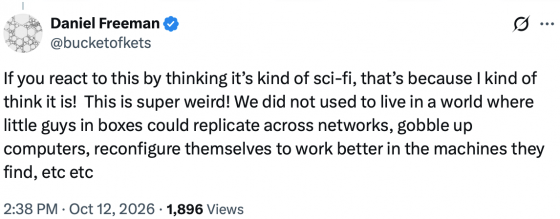
What these researchers are creating could soon escape our control.
And that would be really bad.
But for now, most of those who are working in the AI industry still believe that the benefits will greatly outweigh the costs.
In fact, some researchers have actually started smoking because they are so convinced that AI will ultimately cure cancer…
Forget sleepmaxxing and cold plunging: smoking is the new lifestyle flex among AI researchers.
At least, that’s according to Palantir CTO Shyam Sankar, who said some AI researchers are taking up smoking to signal their belief that AI will eventually cure cancer.
“So many AI researchers have started smoking as a way of signaling to other researchers how much they believe in AI,” Sankar said in an interview on CBS News’ “Face the Nation” on Sunday.
Isn’t that nuts?
Sadly, our entire world is going crazy at this point.
And it would be really crazy for the AI industry to hand the keys over to Bill Gates.
Putting Bill Gates in charge of AI security would be kind of like putting a fox in charge of the henhouse.
Please.
Don’t do it.
But they aren’t going to listen to people like us, are they?
Article posted with permission from Michael Snyder