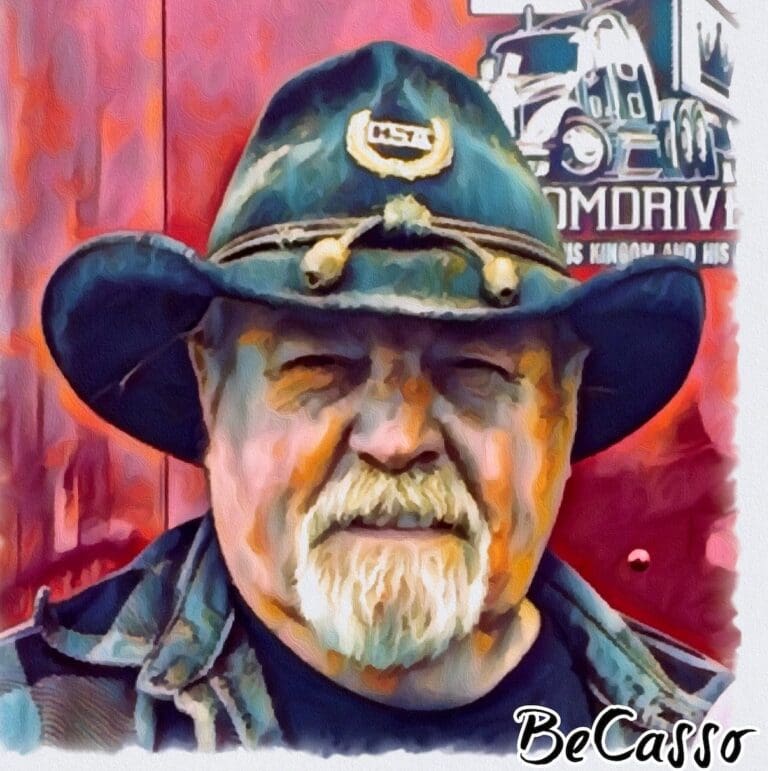
As I grow older, I find myself thinking more often about death. Maybe that is simply part of getting older. Maybe it’s because, as an over the road truckdriver I see life much like a highway with exit ramps, and accidents that develop suddenly out of nowhere, many ending in fatalities. There comes a point when you realize there are considerably more miles behind you than ahead of you. Death ceases to be something that happens mostly to family members, friends, and people in the news. One begins to recognize that somewhere down the road there is an exit with your name on it. You don’t know where it is. You don’t know how far away it is. But you know it is there.
When I say I think about death, though, what I’m thinking of is the life after this life, and getting there from here. Bodies die. Hearts stop beating. Lungs stop breathing. The body that carried us through this world eventually returns to the earth. But as a Christian, I don’t believe the person ceases to exist when the machinery shuts down. I think of physical death as the transition from this physical world into that mysterious unseen realm where God, angels, and the saints who have gone before us dwell.
R. C. Sproul once said that he did not fear death, but he feared dying. There is a considerable difference between being afraid of where you’re going and wondering what it is going to be like getting there.
The destination doesn’t frighten me; but imagining the journey gives me pause.
Some people simply go to sleep and don’t wake up. Others die suddenly from a heart attack, an aneurysm, an accident, or some completely unforeseen event that turns an ordinary Tuesday into the last day of their earthly life. Others travel a long road through cancer, dementia, respiratory disease, chronic pain, or the gradual failure of a body that has simply worn out.
Why does one person live ninety years and another twenty-five? Why does someone whose life seems to be producing enormous good suddenly die, while another lives decades longer? Why are godly fathers taken from young children? Why does one person die peacefully in their sleep, while another dies painfully after months or years of suffering, or a sudden act of violence?
We are told and believe that the Lord appoints our days. So no one dies halfway through the life God intended him to live. That is where providence becomes both comforting and frustrating. I believe God governs these things. I just don’t pretend to understand how or why,
William Cowper captured something of this in his hymn God Moves in a Mysterious Way. He wrote of God’s purposes ripening quickly and unfolding with every passing hour, and then gave us that wonderful picture: “The bud may have a bitter taste, but sweet will be the flower.”
A child dies. A good man is killed. A mother develops cancer. A productive Christian is taken seemingly in their prime. I cannot explain those things, nor am I required to.
Neither do I put much stock in stories of near-death experiences. People describe lights, tunnels, departed relatives, overwhelming peace, angels, or voices. I don’t need somebody else’s feedback to tell me what happens when I die. I have something considerably more reliable. I have the promises of God. I believe even the ones I don’t completely understand.
Paul says that God has already “raised us up with him and seated us with him in the heavenly places in Christ Jesus.” I believe that, although I can’t pretend to explain precisely what it means. But my union with Christ is not simply a future hope; it’s a present reality. My life is hidden with Christ in God. My citizenship is in heaven, by God’s grace.
Not that this life is bad; far from it. God has filled this world with extraordinary goodness. Friendship, food, laughter, marriage, children, grandchildren, work, music, mountains, dogs, oceans, thunderstorms, good conversations and ten thousand ordinary pleasures are gifts of God. But this is not the final destination.
What exactly we are being prepared for is left tantalizingly unclear. But this life seems like preparation for the next, or else what’s the purpose? Scripture certainly does teach that suffering produces things in us that comfort rarely does. Trials expose what we trust. Difficulty reveals character. Weakness destroys illusions of self-sufficiency. Forgiveness teaches us grace. Failure teaches humility. Service teaches love. Even aging itself is presumably intended to teach us not to hold onto this life to tightly. The body begins taking away things we once assumed would always be there. Strength diminishes. Recovery takes longer. Friends disappear. Parents pass away. Our outward man really is wasting away.
But we are told that while this is happening, the inward man can be renewed day by day. If nothing else, aging should loosen our grip on a world in which we were never intended to be permanent residents. Paul, in fact, admitted he had “a desire to depart and be with Christ, for that is far better.” Those last five words deserve attention.
Whatever joys I have experienced, friendships I have known, landscapes I have seen, adventures, pleasures, conversations, meals, accomplishments, laughter, affection, and ordinary moments of contentment have made this life good; being with Christ is not merely comparable. It is far better!
Despite the certainty of this conviction, our natural survival instinct is deeply embedded within us. Living creatures cling to life. Christian courage doesn’t require pretending otherwise. But our instinct for survival doesn’t get the final word.
I find myself frequently reflecting on Revelation 12:11. The saints overcome “by the blood of the Lamb and by the word of their testimony,” and because they did not love their lives even unto death.
I need that.
Because as a I grow older and look backward, I don’t see as many victories as I see wasted time, bad decisions, squandered grace, missed opportunities, sins repeated. I have professed faith in Christ for much of my life, and yet there have been long stretches when my behavior contradicted my profession. That makes the question of finishing well increasingly important to me. I’m not interested in extending my life merely for the sake of accumulating more birthdays. I don’t want the final chapter of my life to contradict the confession I have made. My sins and failures notwithstanding, I determine that Christ should gain a good return for His investment, and that what I am living for should be worth Christ dying for.
Perhaps running life’s race isn’t complicated.. It’s tempting to imagine, however, that finishing well means somehow compensating for everything we did badly. But there isn’t enough time for that, no matter how long we live. Living by faith means, among other things, accepting that some things cannot be repaired by another decade of renewed devotion and faithful obedience. They are only covered by the blood of Christ.
Still, I wonder what the last few seconds here and the first few moments there will be like. I wonder whether the transition will seem instantaneous, what it means to suddenly be absent from the body and present with the Lord. Scripture leaves those questions unanswered. Whatever eternity entails—and I suspect it contains realities beyond our present ability to imagine—the center of the Christian hope is to be with Christ.
And that is far better.
Somewhere ahead of me is my last day. I don’t know whether it is years away or tomorrow. I don’t know whether I will see it coming, or it will take me by surprise. I don’t know whether I will die quietly in my sleep, or whether dying will require courage I don’t presently possess. I may be frightened. It may hurt. I may need somebody beside me reminding me of promises I have spent years telling other people to believe, but if Christ is telling the truth—and I believe with all my heart he is,—then my last moment here will also be my first moment there. All my questions will either be answered or cease to matter. The sins I have fought will never trouble me again. The regrets I carried will finally lose their voice. Faith will no longer be required because faith will have become sight. At last that will be able to love and serve Christ unhindered by the faults and frailty of my present nature.
Thus I find myself thinking less about how much time I have left, and more about what I should be doing today, and with whatever time remains. I want my final testimony to agree with the confession I have made along the way: my hope is not that I did enough or understood enough. My hope is solely in the sufficiency of Christ alone.
Brothers, now we are sons of God, and it does not here yet appear what we shall be. But we know that when we see him, we shall be like him…And that will be the best day of my life!
Article posted with permission from Bill Evans