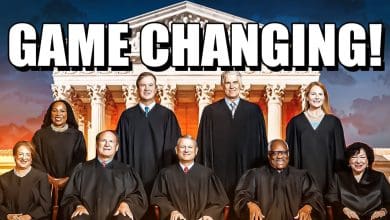
The Jury Box Is Shrinking: Supreme Court Refuses to Hear Sixth Amendment Challenge to Stop Erosion of the Right to Trial by Jury

WASHINGTON, D.C. — At a time when Americans are increasingly being subjected to aggressive policing, politicized prosecutions, and a criminal justice system stacked in favor of the government, the U.S. Supreme Court has once again declined to stop the government from weakening one of the Constitution’s most fundamental protections: the right to trial by jury.
In refusing to hear an appeal in Minor v. Florida, the Supreme Court left intact a state system in which defendants facing serious criminal charges can be tried by juries of only six people instead of the traditional twelve-member jury long understood to be required by the Sixth Amendment. The Rutherford Institute and the ACLU argued in an amicus brief that the Founders understood the word “jury” to mean twelve members when the Constitution and Bill of Rights were ratified, and that allowing states to reduce that number undermines both the integrity of the justice system and the constitutional rights of the accused.
“At a time when prosecutors already hold enormous power over the lives and liberties of ordinary Americans, shrinking juries means fewer voices, less deliberation, and fewer safeguards against malicious prosecutions and government abuse,” said constitutional attorney John W. Whitehead, president of The Rutherford Institute and author of Battlefield America: The War on the American People. “The Constitution was designed to restrain the government—not make wrongful convictions easier.”
While the Sixth Amendment does not specify the exact number of jurors required for a criminal trial, the historical understanding of a “jury” at the time the Constitution and Bill of Rights were ratified overwhelmingly pointed to twelve members. As Justice Neil Gorsuch has observed, “only 6 states…tolerate smaller panels [than twelve jurors]—and it is difficult to reconcile their outlying practices with the Constitution.” Florida is one of those states. The Florida Constitution allows juries of “not fewer than six,” and state law provides that six jurors may decide all non-capital criminal cases.
The Rutherford Institute and the ACLU have repeatedly urged the U.S. Supreme Court to address what they argue is a dangerous departure from the Constitution’s original meaning and from centuries of American legal tradition. In an earlier case raising the same issue, Justices Gorsuch noted in a dissent that “a mountain of evidence suggests that, both at the time of the Amendment’s adoption and for most of our Nation’s history, the right to a trial by jury for serious criminal offenses meant a trial before 12 members of the community—nothing less.” Historically, even small reductions in jury size were viewed as incompatible with the Constitution.
The concern is not merely historical or procedural. Empirical research cited indicates that smaller juries are less likely to reflect diverse viewpoints, more likely to overlook dissenting opinions, and more likely to favor the prosecution. By contrast, twelve-member juries deliberate longer, recall evidence more accurately, and provide stronger safeguards against wrongful convictions and government overreach.
At a time when Americans are confronting expanding prosecutorial power, increasingly politicized and aggressive law enforcement tactics, and growing public distrust in the fairness of the criminal justice system, The Rutherford Institute warns that weakening the jury system further erodes one of the Constitution’s last protections against unchecked government authority.
Alejandra Ávila, Annamaria M. Morales-Kimbal, and Natalie E. Giotta of Kellogg, Hansen, Todd, Figel & Frederick, P.L.L.C., advanced the arguments in the brief with help from previous amicus brief arguments advanced by Stuart Banner of the UCLA School of Law Supreme Court Clinic.
The Rutherford Institute, a nonprofit civil liberties organization, provides legal assistance at no charge to individuals whose constitutional rights have been threatened or violated and educates the public on a wide spectrum of issues affecting their freedoms.
Case History
August 25, 2022 • Rutherford Institute Challenges Government Efforts To Undermine Sixth Amendment Rights, Unfairly Deny Protections to Citizens in Criminal Cases
November 23, 2022 • Supreme Court Allows Government to Deny Sixth Amendment Protections to Citizens in Criminal Cases, Disregard Right to Twelve-Person Jury Trial
Minor v. Florida
Article posted with permission from John Whitehead